A Tour of Treeleaf Tsukuba

Collapse
This is a sticky topic.
X
X
 
  • Time
  • Show
Clear All
new posts
  • Jundo
    Treeleaf Founder and Priest
    • Apr 2006
    • 43990

    A Tour of Treeleaf Tsukuba

    I heard that some folks who attend our Treeleaf Zazenkai wonder what the rest of our Zendo looks like, as the camera angle only shows a bit. Here is much, MUCH more than anyone needs to know ...

    If anyone is curious, I made this video tour a few years ago, and a couple of scrolls and statues have been added (see below), but it is 90% the same.
    .
    TREELEAF ZENDO TSUKUBA TOUR VIDEO


    The second floor is empty ... and a bit unsafe with the old floor ... so only used for storage.
    .
    I mention our "Beat-Up Buddha" ... a fellow who has seen the hard knocks of life, for sure, maybe a black eye ... and here is a close up, as a little hard to see ... fitting for a Sangha made up of folks who have seen some scars and hard knocks ...
    .
    adv5.jpg
    .
    And the official Soto sect image of Shakyamuni Buddha with Master Dogen on the right and Keizan on the left ...

    image.png

    Since the film was made, we added a calligraphy (left) by Nishijima Roshi which says "All the World in the Ten Directions is One Bright Pearl" ... and a Kannon statue that belonged to my wife's family ...
    . adv5.jpg


    In front of the 1000 Armed Kannon are portraits of my Dharma Mentors, teachers who had great influence on me and the making of Treeleaf, right to left, Kantor Roshi, Azuma Roshi, Sargent Roshi
    . image.png

    To the left side of our central altar, not visible, is another framed calligraphy by Nishijima Roshi ... Shikantaza ... and on the right side of the Altar in same style 赤心片々 Seki shin hen-hen, signed by 愚道和夫 Gudō Wafu ... Translated literally, it means red mind moment by moment ... the mind that is sincere moment by moment ...

    . image.png

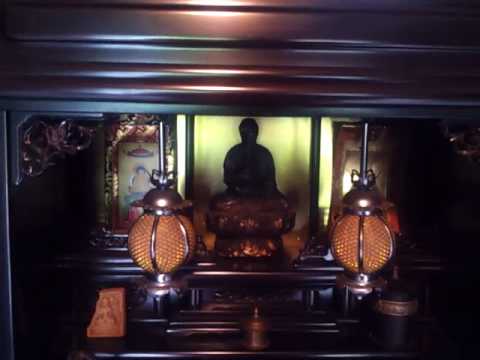
    Here is the Vairochana Buddha that is now with us sitting in front a scroll of the Heart Sutra from Taiwan, the scroll a gift from Ven. Yifa when I was invitied there, next to the "Bright Pearl" calligraphy by Nishijima Roshi. Vairochana the Cosmic or Universal Buddha Dharmakaya ... The Vairochana Buddha statue is actually only about 8 inches tall ...
    . adv2.jpg


    image.png


    and on the central Alter (seen in the photo above), there is Mongen (Manjushri) Bodhisattva riding his lion ... It is traditional to have Mongen on a Zendo Altar ...
    .
    We were also gifted with a statue ... but there is some mystery to it. The man who donated said it brought him bad luck. After he donated, the statue seems happy, and I think the man had better luck.
    . adv3.jpg

    Based on the uniqueness of the design, very rare in several ways, and the similarities, I have come to the conclusion that it is a much more recent piece vaguely based on a 1200 year old national treasure from the Tendai Gantokuji temple in the ancient capital of Kyoto ... traditionally identified as a Kannon (Guan-yin), the Bodhisattva of Compassion, however, experts have doubts about that and believe that it could be Miroku (Maitreya) Bodhisattva, the Future Buddha (for reasons discussed here: LINK) ... and this is a Zen Sangha of "Building the Future Buddha," so I see Maitreya ...


    (CONTINUED BELOW)
    Last edited by Jundo; 10-07-2025, 02:51 AM.
    ALL OF LIFE IS OUR TEMPLE
  • Jundo
    Treeleaf Founder and Priest
    • Apr 2006
    • 43990

    #2
    (CONTINUED)


    Here is Keshiro Aita, the Japanese carpenter who did the woodwork for our Zendo (and dear friend, shown in this photo, who still stops around our house every few weeks to bring my family vegetables from his farm field.)
    . image.png

    The plaque over the door ... Ko no Ha ... Treeleaf Zendo ... by Nishijima Roshi ...
    . adv6.jpg

    The building was a "naya / 納屋." You could say "shed" or "barn" or "storehouse." The second kanji 屋 means room or small building. The first Kanji means storage, supply, among other meanings: 納.

    It's purposes were many, including storage of farm tools. But also cultivation of the nae 苗 seedling, sapling, shoot. So, my research disclosed that the name may also derive (in pre-literate times) as "naeya." Or, it could be a dialect pronunciation of "no" (which can mean agriculture if one kanji 農, or the above storage 納), but pronounced in dialect or old pronunciation maybe as "na" instead of "no."

    It was not a "barn" for animals, like cows, pigs and horses (there may have been larger ones that were used for that, however, and there are the ruins of a pig house on our land). It was the workspace where they would store things (farm implements) and do a lot of farm work like running the hand-turned machine that takes the hulls off the rice, grinding wheat, storing the harvested crops, sorting and packing vegetables, making miso, preparing the seedlings, etc.

    Folks in our neighborhood still use them for such things. Here is a picture of one where they have the rice hulling machine (now powered) on the left, and are drying vegetables hanging from the naya.
    . image.png


    We have an old map that shows that some Naya has been in that location since at least 150 years ago (see below, probably much much longer), although it has to be rebuilt once in awhile. I think that the current one is maybe 60 years old, so about my age. It is in about the same physical shape as me too, a few scars.
    .
    Here is an example of the mud, straw and bamboo walls I mentioned, much stronger than it looks. The columns rest on stone or concrete edges, not really attached to anything, like here, but it is the way that Japanese buildings have been built, and withstood earthquakes, for more than a thousand years:

    image.png


    ​And that is much more than anyone needs to know just to Sit Zazen there.

    Gassho, Jundo
    stlah​
    Last edited by Jundo; 10-21-2025, 01:51 AM.
    ALL OF LIFE IS OUR TEMPLE

    Comment

    • Hoshuku
      Member
      • May 2017
      • 269

      #3
      It all has a very lived in vibe rather like many of us.

      Bows,
      Hoshuku
      Satlah

      Comment

      • Seikan
        Member
        • Apr 2020
        • 1004

        #4
        Originally posted by Bion

        maybe it's just me, but I can't see the photos.. I see blank items.. This is what I see on both desktop and phone:
        Same here. The photos and video in the first post show up fine, but the second post above is full of broken links.

        I am enjoying the video, however. I always assumed that there was little to see on the right side of the Zendo, but it's just as big as the left! I imagine that must be were all the visiting dignitaries sit when they visit...

        Gassho,
        Seikan
        stlah
        聖簡 Seikan (Sacred Simplicity)

        "See and realize / that this world / is not permanent. / Neither late nor early flowers / will remain."
        —Ryokan

        Comment

        • Jundo
          Treeleaf Founder and Priest
          • Apr 2006
          • 43990

          #5
          Originally posted by Bion

          maybe it's just me, but I can't see the photos.. I see blank items.. This is what I see on both desktop and phone:
          The pictures should be there now.

          Gassho, J
          stlah
          ALL OF LIFE IS OUR TEMPLE

          Comment

          • Shinshi
            Senior Priest-in-Training
            • Jul 2010
            • 4223

            #6
            Thank you for posting the video Jundo. I don't remember seeing it before.

            Gassho,

            Shinshi
            空道 心志 Kudo Shinshi

            For Zen students a weed is a treasure. With this attitude, whatever you do, life becomes an art.
            ​— Shunryu Suzuki

            E84I - JAJ

            Comment

            • Seiraku
              Member
              • Feb 2025
              • 44

              #7
              Thank you Jundo! We were talking about this at the last Floating tea house, it’s great to see what the Zendo looks like it feels very warm and inviting.

              Gassho,
              Brogan
              sat

              Comment

              • Jundo
                Treeleaf Founder and Priest
                • Apr 2006
                • 43990

                #8
                Originally posted by Brogan
                Thank you Jundo! We were talking about this at the last Floating tea house, it’s great to see what the Zendo looks like it feels very warm and inviting.

                Gassho,
                Brogan
                sat
                Except in the winter when it is cold, and the heart of summer when it is very hot. Fortunately, we sit there beyond "hot and cold."

                Once a monk in training asked Great Master Dongshan, “When heat and cold come, how can I avoid them?”
                Dongshan said, “Why don’t you go where it’s neither hot nor cold?”
                The monk, “What is this place of no heat or cold?”
                To this Dongshan replied, “When it’s hot, become one with the heat; when it’s cold, become one with the cold. That is the place of no heat or cold.”
                (Some versions say, “When it is cold, let it be so cold that it kills you. When hot, let it be so hot that it kills you.”)


                Also, we have nice oil heaters and two nice electric fans.

                Gassho, Jundo
                stlah
                ALL OF LIFE IS OUR TEMPLE

                Comment

                • Ryumon
                  Member
                  • Apr 2007
                  • 1896

                  #9
                  So is the Japanese name of the temple Konoha-ji?

                  Gassho,

                  Ryūmon (Kirk)

                  Sat Lah
                  I know nothing.

                  Comment

                  • Jundo
                    Treeleaf Founder and Priest
                    • Apr 2006
                    • 43990

                    #10
                    Originally posted by Ryumon
                    So is the Japanese name of the temple Konoha-ji?

                    Gassho,

                    Ryūmon (Kirk)

                    Sat Lah
                    I would not say that we are a temple. It is a Zen Center, so Konoha Zendo.

                    Gassho, J
                    stlah
                    ALL OF LIFE IS OUR TEMPLE

                    Comment

                    • cloudtyger
                      Member
                      • Jul 2025
                      • 35

                      #11
                      Thank you for this Jundo. I love Japanese architecture so much. Seeing 「木之葉 」my first inclination would be to read it ki no ha, but I like the bit of phonetic wordplay between ko no ha (tree leaf/foliage) and kono ha (this leaf). It brings to mind the imagery of the Dharma as a great tree, a spiritual Bodhi tree, with each sangha as a branch, and each Buddhist as a leaf, helping to keep the Dharma alive in the way that leaves bring light and life to a tree.

                      Gasshō
                      sat/lah
                      Marykate
                      Last edited by cloudtyger; 10-14-2025, 09:21 PM.

                      Comment

                      • Jundo
                        Treeleaf Founder and Priest
                        • Apr 2006
                        • 43990

                        #12
                        Originally posted by cloudtyger
                        Thank you for this Jundo. I love Japanese architecture so much. Seeing 「木之葉 」my first inclination would be to read it ki no ha, but I like the bit of phonetic wordplay between ko no ha (tree leaf/foliage) and kono ha (this leaf). It brings to mind the imagery of the Dharma as a great tree, a spiritual Bodhi tree, with each sangha as a branch, and each Buddhist as a leaf, helping to keep the Dharma alive in the way that leaves bring light and life to a tree.

                        Gasshō
                        sat/lah
                        Marykate
                        That is exactly where the name Treeleaf derives. You got it.

                        As to "ko" for 木, that is one traditional pronunciation, especially in more classical Japanese form...

                        ⟨ko2⟩ → */kə/ → /ko/

                        From Old Japanese (ko2).

                        Likely the original form of ki above. Obsolete in modern Japanese, never found in isolation; only found in compounds and certain idioms
                        derived terms

                        image.png

                        Gassho, J
                        stlah
                        ALL OF LIFE IS OUR TEMPLE

                        Comment

                        Working...