Sewing the Kesa

Collapse
X
 
  • Time
  • Show
Clear All
new posts
  • Meitou
    Member
    • Feb 2017
    • 1655

    #31
    Originally posted by Kyoshin
    I don't enjoy those tasks either. Personally, I hated every second I spent sewing the rakusu. That's why it was so important and one of the most valuable experiences of my life. One day I'll work up the gumption to have a go at the kesa, but not for a while.

    Gassho
    Kyōshin
    Satlah

    Sent from my Pixel using Tapatalk
    I can't say I hated it, but I cried a lot! Sewing brought up so much for me - how inept I was made to feel in Domestic Science classes in school, how difficult how I found it to be accurate when cutting and sewing, how hopeless I was at any kind of math and how much I hated it - all that school stuff came right back to haunt me 50 years later. But while sewing I thought about how I'd bought into that narrative over the years, how I'd allowed it to define me when in reality that wasn't my story at all, I could have just put it all down. Sewing the rakusu, facing my fears about my abilities, crying, unpicking, starting again, crying some more, starting again some more, and finding at the end of this painful journey that I had created this beautiful thing, as if I'd stitched an entire history into it - that's my real story.
    Gassho
    Meitou
    satwithyoualltoday/lah
    命 Mei - life
    島 Tou - island

    Comment

    • Jundo
      Treeleaf Founder and Priest
      • Apr 2006
      • 44329

      #32
      Originally posted by sjlabat
      Really interesting posts...esp regarding rakusu vs kesa. I had wondered about the sewing and usage of the two, if there was a 'substantial' difference (since they are pretty much the same thing) or a customary difference. -I may not be expressing myself artfully, I hope you get my meaning.
      gassho
      sean
      sat.lah
      Historians are not sure, but the Rakusu (literally, "Abbreviated" [Kesa]) may have developed simply when monks had tasks whereby it was inconvenient to always be wearing the full Kesa (they are still worn by Japanese monks at such times, which is most of the day, with the full Kesa usually for Ceremonies and more formal times), or perhaps during times or persecution of Buddhism in China when they had to go "undercover" and wore the Rakusu hidden inside their clothes. They are more common in Japan, and a version in Korea (I am not sure if that came from Japanese influence), than other places. Now, the Rakusu is also bestowed on Lay Folks during Jukai, although not universally (in Japan, I have been to Jukai where no Rakusu was bestowed, and others where it was.)

      Japanese temple parishioners, with or without regard to whether they have formally undertaken the Precepts, also often wear an even more abbreviated form called a "Wagesa" (circle Kesa).


      Outside the Zen sects, there are some other variations worn by the Pure Land folks and such ...

      Jundo Note: There is absolutely no reason that folks at Treeleaf need to know anything whatsoever about Wagesa (one s'or two) or Hangesa, the subject of this thread. For Zen Trivia buffs only. :) I was reading Domyo Burke’s podcast on “Taking Refuge and the Precepts” today https://zenstudiespodcast


      I understand that some Soto groups (like OBC) in the West, and many temples in Japan, bestow a Wagesa for Jukai instead of a Rakusu.

      Ever see anything like any of those in Vietnam, Kyoshin?

      Gassho, J

      STLah
      Last edited by Jundo; 06-03-2019, 01:59 AM.
      ALL OF LIFE IS OUR TEMPLE

      Comment

      • Kyoshin
        Member
        • Apr 2016
        • 308

        #33
        Originally posted by Jundo
        Historians are not sure, but the Rakusu (literally, "Abbreviated" [Kesa]) may have developed simply when monks had tasks whereby it was inconvenient to always be wearing the full Kesa (they are still worn by Japanese monks at such times, which is most of the day, with the full Kesa usually for Ceremonies and more formal times), or perhaps during times or persecution of Buddhism in China when they had to go "undercover" and wore the Rakusu hidden inside their clothes. They are more common in Japan, and a version in Korea (I am not sure if that came from Japanese influence), than other places. Now, the Rakusu is also bestowed on Lay Folks during Jukai, although not universally (in Japan, I have been to Jukai where no Rakusu was bestowed, and others where it was.)

        Japanese temple parishioners, with or without regard to whether they have formally undertaken the Precepts, also often wear an even more abbreviated form called a "Wagesa" (circle Kesa).


        Outside the Zen sects, there are some other variations worn by the Pure Land folks and such ...

        Jundo Note: There is absolutely no reason that folks at Treeleaf need to know anything whatsoever about Wagesa (one s'or two) or Hangesa, the subject of this thread. For Zen Trivia buffs only. :) I was reading Domyo Burke’s podcast on “Taking Refuge and the Precepts” today https://zenstudiespodcast


        I understand that some Soto groups (like OBC) in the West, and many temples in Japan, bestow a Wagesa for Jukai instead of a Rakusu.

        Ever see anything like any of those in Vietnam, Kyoshin?

        Gassho, J

        STLah
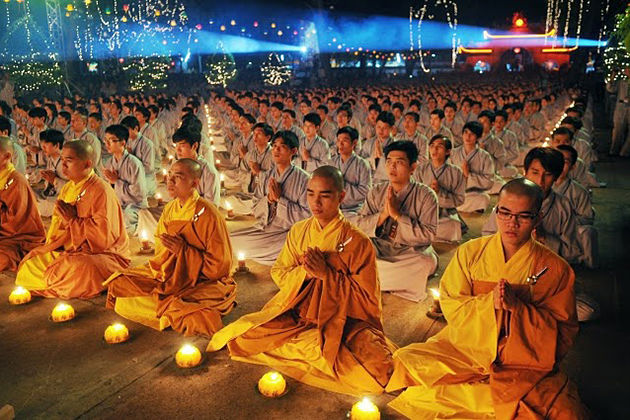
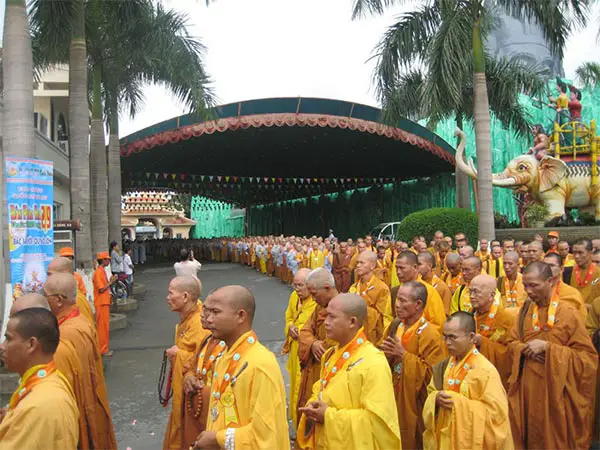
        No, I haven't seen anything like that, but I haven't made it to the Thien (Viet Zen) temple yet, which is pretty far. At temples I have been to all the monk wear something like these two styles. Colors vary, but grey and brown seem most common. I've never seen laity wear any special clothing, though prayer bead bracelets and Thai style pendants are popular.

        Gassho
        Kyōshin
        Satlahvietmonk1.jpg

        Sent from my Pixel using Tapatalk
        Last edited by Kyoshin; 06-03-2019, 02:16 AM.

        Comment

        • Jundo
          Treeleaf Founder and Priest
          • Apr 2006
          • 44329

          #34
          Originally posted by Kyoshin
          No, I haven't seen anything like that, but I haven't made it to the Thien (Viet Zen) temple yet, which is pretty far. At temples I have been to all the monk wear something like these two styles. Colors vary, but grey and brown seem most common. I've never seen laity wear any special clothing, though prayer bead bracelets and Thai style pendants are popular.

          Gassho
          Kyōshin
          Satlah[ATTACH]5676[/ATTACH]
          Of course, Vietnamese monks wear full Kesa too on formal times. Most all are Rinzai Lineage, I believe, and have that Chinese style hook ...


          And I even see a few images with something that looks surprisingly like the "Wagesa" ... although the seem to be wearing it together with the full Kesa (a no no in Japan ... belt and suspenders)


          Well, Vietnamese noodles and Chinese noodles and Japanese noodles ... all delicious!

          Gassho, J

          STLah
          Last edited by Jundo; 06-03-2019, 04:39 AM.
          ALL OF LIFE IS OUR TEMPLE

          Comment

          • Kyoshin
            Member
            • Apr 2016
            • 308

            #35
            Originally posted by Jundo
            Of course, Vietnamese monks wear full Kesa too on formal times. Most all are Rinzai Lineage, I believe, and have that Chinese style hook ...


            And I even see a few images with something that looks surprisingly like the "Wagesa" ... although the seem to be wearing it together with the full Kesa (a no no in Japan ... belt and suspenders)


            Well, Vietnamese noodles and Chinese noodles and Japanese noodles ... all delicious!

            Gassho, J

            STLah
            I haven't personally seen any monks wearing the full kesa, but I know it happens for formal occasions. In fact you don't see monks often here at all, unlike Thailand or Cambodia where they're everywhere. I've seen a few monks at temples, but oddly enough, I see them most frequently at the airport.
            Gassho
            Kyōshin
            Satlah

            Sent from my Pixel using Tapatalk

            Comment

            • Meian
              Member
              • Apr 2015
              • 1683

              #36
              How did I miss this thread with such beautiful photos and the precious history? I cherish this, all the cultures of Buddhism. Thank you for sharing these stories, the customs and traditions. It gives me a very warm, peaceful, comforting feeling inside.

              I had started measuring and cutting a few pieces here and there, practicing for the rakusu. I had practised the stitches before, but never got farther (fear). I now realize it is similar to what Meitou described. Home Ec and similar attempts were the same for me, and how my fingers, etc are not so nimble as 40 years ago. So I thought, I'll just try practicing, a little at a time, and I'll see that it's not so bad. Then when it's time, I'll be less afraid of it.

              Now I understand the kesa is after the rakusu. Do I dare to dream that much? One dragon at a time, I think.

              Grateful for this thread.

              Gassho
              Kim
              St lh


              Sent from my SM-G930U using Tapatalk
              鏡道 |​ Kyodo (Meian)
              "Mirror of the Way"
              visiting Unsui, not a teacher

              Comment

              • Tai Shi
                Member
                • Oct 2014
                • 3485

                #37
                I have deep regret and even embarrassment at having received my Rakusu as a gift of the (someone sewed it for me) The Sangha (tears of gratitude). My left hand is somewhat mangled because of a self-inflicted fishing accident. My wife sewed my beautiful black covering and gray brocade interior Rakusu cover out of scraps in her sewing kit, and this according to requirements. She took the pattern right out of the Sangha, Buddha, Dharma, Sangha, what's that we say? I feel sometimes at a loss, but someday maybe someone will show me a way to sew a Rakusu for someone. I look at bought Kasa and I know it wouldn't be the same if I bought one, but monks look wonderful in their colors. Beside, on July 22nd I will have something that, perhaps, no one in our Sangha has; a 32-year AA medallion for 32 years continuous freedom from alcohol and street drugs. All that this means is that I've done what my step-mom, Marilyn, or my mother, Dorothy, did naturally in their lives. One day at a time, sometime one moment at a time. These women knew God, a God of their own understanding.

                Tai Shi
                sat/lah
                Gassho
                Last edited by Tai Shi; 06-03-2019, 11:46 PM.

                Comment

                • Jundo
                  Treeleaf Founder and Priest
                  • Apr 2006
                  • 44329

                  #38
                  For those really into cultural comparisons ...

                  A Theravadan monk (from Laos actually ... I've been there!) demonstrates how to place on their robes. (Actually, I am not sure about the fact that he puts one corner in his mouth at one point Also, what about those rules about speaking to girls? ) ... Boy, we Soto folks seem to have it relatively easy! ...


                  And a Chinese priest ... This is almost the same as our way but, this time, because of the hook, the Soto folks have more tying steps ... This is the Chinese lay robe, by the way ...


                  And a fellow whom I believe to be a True Pure Land (Jodo Shin-shu) priest putting on their 5-Panel Kesa


                  Gassho, J

                  STLah
                  Last edited by Jundo; 06-04-2019, 02:00 AM.
                  ALL OF LIFE IS OUR TEMPLE

                  Comment

                  • Ippo
                    Member
                    • Apr 2019
                    • 275

                    #39
                    Originally posted by Kyoshin
                    I don't enjoy those tasks either. Personally, I hated every second I spent sewing the rakusu. That's why it was so important and one of the most valuable experiences of my life. One day I'll work up the gumption to have a go at the kesa, but not for a while.

                    Gassho
                    Kyōshin
                    Satlah

                    Sent from my Pixel using Tapatalk
                    Hi Kyoshin,

                    Thank you very kindly for sharing your experience. I can imagine myself feeling the same and learning to accept and sit with the experience every stitch. I hope you undertake the full kesa sewing one day too. It sounds like a very valuable experience.

                    Warm wishes

                    Gassho,

                    Brad

                    SatLah
                    一 法
                    (One)(Dharma)

                    Everyday is a good day!

                    Comment

                    • Ippo
                      Member
                      • Apr 2019
                      • 275

                      #40
                      Hey Shingen,

                      Thank you very much for the invitation. I feel I am ready for the journey and Tree Leaf feels, absolutely, like the right place for me! I will have a chance to sit with you on Friday so I will see you then!

                      Gassho,
                      Brad

                      Sat/Lah
                      一 法
                      (One)(Dharma)

                      Everyday is a good day!

                      Comment

                      • Mp

                        #41
                        Originally posted by BradR89
                        Hey Shingen,

                        Thank you very much for the invitation. I feel I am ready for the journey and Tree Leaf feels, absolutely, like the right place for me! I will have a chance to sit with you on Friday so I will see you then!

                        Gassho,
                        Brad

                        Sat/Lah
                        Hey Brad,

                        Look forward to sewing and practicing with you ... if you have any questions, please feel free in contacting me anytime. =)

                        Gassho
                        Shingen

                        Sat/LAH

                        Comment

                        • Meian
                          Member
                          • Apr 2015
                          • 1683

                          #42
                          Jundo, thank you for the videos, history, traditions, and cultural comparisons. I am always interested in these things and often research it on my own, just because.

                          Gassho
                          Kim
                          St lh

                          Sent from my SM-G930U using Tapatalk
                          鏡道 |​ Kyodo (Meian)
                          "Mirror of the Way"
                          visiting Unsui, not a teacher

                          Comment

                          • jirkasirkabublinka
                            Member
                            • Jun 2019
                            • 2

                            #43
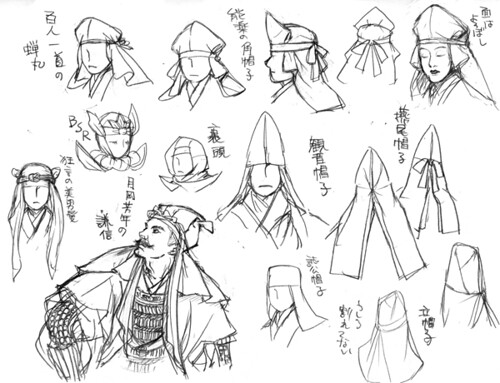
                            Guys, I know it´s little bit of topic, but do anyone of you know how is called the kind of hat/cap (?) Sodo Yokoyama and Kodo Sawaki wore? https://terebess.hu/zen/mesterek/yokoyama.html


                            ?

                            Comment

                            • Jundo
                              Treeleaf Founder and Priest
                              • Apr 2006
                              • 44329

                              #44
                              Originally posted by jirkasirkabublinka
                              Guys, I know it´s little bit of topic, but do anyone of you know how is called the kind of hat/cap (?) Sodo Yokoyama and Kodo Sawaki wore? https://terebess.hu/zen/mesterek/yokoyama.html


                              ?
                              Hello,

                              Would you mind introducing yourself here, JP?


                              Thank you.

                              I am also curious as to why you are interested in the hat?

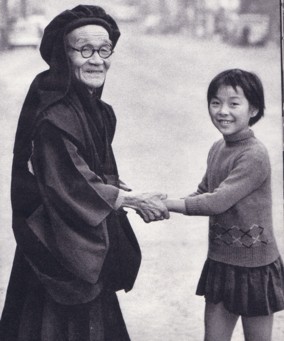
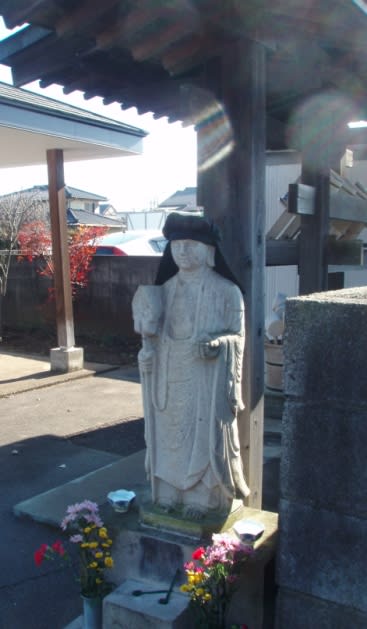
                              That type of hat is rather out of style with priests these days, so not seen very much. Sometimes they cover the heads of statues of Jizo.


                              It is called a 不老帽, which I believe is pronounced "furoubo," and means "perennial youth hat." Why? I do not know. Perhaps because the nice sun flap keeps the skin young??

                              It is closely related to very old style hats from samurai times, as seen in this picture.


                              A similar hat is worn by the God of Wealth, Daikoku, whose statue is often found in Zen temples (don't ask why, probably the ancient merchant connection), and he wears a hat that is similar. So, that is called a Daikoku zukin (Daikoku head cover 大黒頭巾)


                              On their 60th birthday here, to mark their return to "second youth", men get dressed up in big red ones and look silly (I guess I can look forward to this next year!?) Maybe that is where the "perennial youth" is connected??


                              Gassho, J

                              STLah
                              Last edited by Jundo; 06-21-2019, 05:54 AM.
                              ALL OF LIFE IS OUR TEMPLE

                              Comment

                              • Shonin Risa Bear
                                Member
                                • Apr 2019
                                • 961

                                #45
                                As to headgear, I am curious about the sode-zukin as worn by the wonderful actress playing Taira no Tokiko in the NHK series Yoshitsune, along with other nuns around that time as pictured both contemporaneously and in current media. Is this a thing at all? I didn't see it worn by any Zen nuns, for example in Paula Arai's study Women Living Zen.

                                29409370190_831ecf42c0_o.jpg

                                gassho
                                doyu sat tday and lent a hand
                                Visiting priest: use salt

                                Comment

                                Working...