Sun. May 17th: A Special Zazenkai with Zen Historian Dr. Steven Heine

Collapse
X
 
  • Time
  • Show
Clear All
new posts
  • Jundo
    Treeleaf Founder and Priest
    • Apr 2006
    • 44503

    Sun. May 17th: A Special Zazenkai with Zen Historian Dr. Steven Heine


    Dear All,

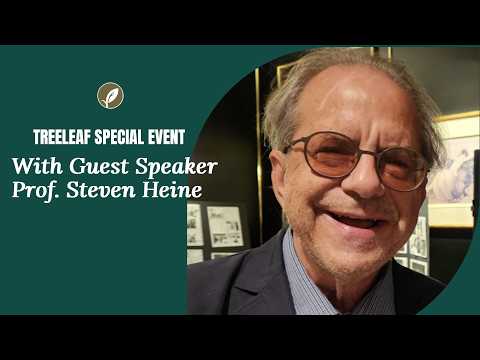
    I am pleased to announce that Buddhism & Zen historian, the noted specialist on the life and writings of Master Dogen, Prof. Steven Heine, will be joining us for a return visit and a very special Zazenkai and Talk on SUNDAY May 17th, LIVE from Miami, USA and Treeleaf Tsukuba.

    Steven Heine is professor of religious studies and history and director of Asian studies at Florida International University. Just a few of his many books and writings, as author or editor, include From Chinese Chan to Japanese Zen: A Remarkable Century of Transmission and Transformation (Oxford); Zen and Material Culture (Oxford); Chan Rhetoric of Uncertainty in the Blue Cliff Record: Sharpening the Sword at the Dragon's Gate (Oxford); Zen Koans (Hawaii); Like Cats and Dogs: Contesting the Mu Kōan in Zen Buddhism (Oxford); Dōgen and Sōtō Zen: New Perspectives (Oxford); Dōgen: Textual and Historical Studies (Oxford); Zen Skin, Zen Marrow: Will the Real Zen Buddhism Please Stand Up? (Oxford); Did Dōgen Go to China? What He Wrote and When He Wrote It (Oxford); Opening a Mountain: Kōans of Zen Masters (Oxford); Shifting Shape, Shaping Text: Philosophy and Folklore in the Fox Kōan (Hawaii); The Zen Poetry of Dōgen: Verses From the Mountain of Eternal Peace (Tuttle); Dōgen and the Kōan Tradition: A Tale of Two Shōbōgenzō Texts (SUNY); Existential and Ontological Dimensions of Time in Heidegger and Dōgen (SUNY); and The Zen Canon: Studies of Classic Zen Texts (Oxford) and more.

    The festivities for our Zazenkai will begin at 10am in New York, 7am in California, London 3pm and Paris 4pm, all SUNDAY May 17th. Click the button below to see the local time for this event. CALENDAR LINK

    Our sitting schedule will look like the following: About 5 or so minutes of Zazen, a Talk by Steve for about 30 minutes or so, and some Questions from our Treeleaf participants. I anticipate the the event will be about an hour to 90 minutes.

    The topic of the talk this time:

    Dr. Heine's new book centers on Wansong Xingxiu (1166–1246), a pivotal figure in Caodong Chan/Sōtō Zen development, and a participant in the compilation of two influential Caodong/Sōtō Koan collections: Tongxuan's 100 Chan Questions (the main focus of Dr. Heine's book) which represents a crucial, although lesser-known, phase of Caodong Chan history centered on northern China, and the Shoyoroku (Book of Serenity) which is better known today and widely cherished by Sōtō Zen folks. Although Wansong lived during the time Dogen was in China, they likely never met in person because in very distant parts of China, and Dogen may not have had direct knowledge of either Koan collection during his lifetime. However, in his talk, Professor Heine will examine the historical and spiritual irony connecting these two pivotal figures in the development of Caodong/Sōtō thought and literature, illustrating his points with several key examples from their respective works.
    .
    You can join the event on Zoom LIVE with camera and microphone so that we can see and hear you (however, “one way” live sitters who do not wish to be seen or to speak are encouraged to come into the Zoom sitting either way, even if you leave the camera and microphone turned off or not connect them). The event will also be streamed lived on YouTube for anyone that cannot join the Zoom room. For local times for this event, please check the Practice Calendar.

    To join this event live on Zoom, please click the button here:Join Meeting

    FOLKS HAVING QUESTIONS FOR DR. HEINE CAN EMAIL ME DURING THE Q&A PORTION HERE (JUNDOTREELEAF@GMAIL.COM), and I will check from time to time, and ask as many questions from viewers as possible.

    I hope that we will have a big turnout, with many folks joining us in our Zoom Room.

    Let's all get together to welcome Dr. Heine and learn a little about the history of our tradition!

    Gassho, Jundo
    stlah

    DONATION:

    The event is free, but those who can afford to make a voluntary donation, can do so here: DONATE
    .​ image.png

    image.png
    Last edited by Jundo; 05-13-2026, 06:49 AM.
    ALL OF LIFE IS OUR TEMPLE
  • Kotei
    Dharma Transmitted Priest
    • Mar 2015
    • 5188

    #2
    Just pushing this thread up, as Prof. Steven Heine will be visiting this coming Sunday.
    Looking very much forward to his visit!
    Bows,
    Kotei sat/lah today.
    義道 冴庭 / Gidō Kotei.

    Comment

    • Junsho
      Member
      • Mar 2024
      • 445

      #3
      Once again, I believe that I will be an youtube expectator. Looking forward too

      Gassho and deep bows
      SatLah
      Junshō 純聲 - Pure Voice, Genuine Speech

      Each time we fall asleep, we die; each time we wake, we are reborn.

      Comment

      • Shui_Di
        Member
        • Apr 2008
        • 408

        #4
        I am looking forward for this

        Gassho, Mujo
        Stlah
        Practicing the Way means letting all things be what they are in their Self-nature. - Master Dogen.

        Comment

        • Bion
          Dharma Transmitted Priest
          • Aug 2020
          • 7101

          #5
          Hello, everyone. I wanted to remind you of this special event tomorrow! I hope to see many of you there, enjoying prof. Heine's lecture!

          Gassho
          sat lah
          "One uninvolved has nothing embraced or rejected, has sloughed off every view right here - every one."

          Comment

          • Onkai
            Dharma Transmitted Priest
            • Aug 2015
            • 3717

            #6
            Big thanks to Prof. Steven Heine and Jundo and everyone who came to the talk. It was about a history I had been unaware of. I was especially interested in the influence of the Huayuan (spelling?) teachings.

            Gassho, Onkai
            Sat lah
            美道 Bidou (Beautiful Way)
            恩海 Onkai (Merciful/Kind Ocean)
            She/her
            I will always have a lot to learn

            Comment

            • Taiji
              Member
              • Jun 2025
              • 171

              #7
              Likewise extending my thanks for this talk, to Profesor Heine, to Jundo, and all who facilitated and attended! I feel like I got just a glimpse of a huge body of knowledge I know nothing about, and I look forward to learning more about it as time goes on!

              Gassho,
              Taiji
              Sat/LAH Today
              Taiji / 泰侍
              "Peaceful Samurai"

              Comment

              • Jundo
                Treeleaf Founder and Priest
                • Apr 2006
                • 44503

                #8
                Originally posted by Onkai
                Big thanks to Prof. Steven Heine and Jundo and everyone who came to the talk. It was about a history I had been unaware of. I was especially interested in the influence of the Huayuan (spelling?) teachings.

                Gassho, Onkai
                Sat lah
                Huayan is the "Flower Garland" ("Avataṃsaka" in Sanskrit) school of Buddhist teachings, and the very large Sutra of the same name (although much of the Huayan philosophy is actually developed apart from the Sutra), which is most well known for its teachings on the interpenetration and interidentity of all phenomena. Its most famous image is "indra's Net."

                A frequently cited expression of this vision of reality is the simile of Indra’s Net from the Avatamsaka Sutra, which was further elaborated by the Huayan teachers. The whole universe is seen as a multidimensional net. At every point where the strands of the net meet, jewels are set. Each jewel reflects the light reflected in the jewels around it, and each of those jewels in turn reflects the light from all the jewels around them, and so on, forever. In this way, each jewel, or each particular entity or event, including each person, ultimately reflects and expresses the radiance of the entire universe. All of totality can be seen in each of its parts.

                Another time, Fazang illustrated the Huayan teachings for Empress Wu by constructing a hall of mirrors, placing mirrors on the ceiling, floor, four walls, and four corners of a room. In the center he placed a Buddha image with a lamp next to it. Standing in this room, the empress could see that the reflection in any one mirror clearly reflected the reflections from all of the other mirrors, including the specific reflection of the Buddha image in each one. This fully demonstrated the unobstructed interpenetration of the particular and the totality, with each one contained in all, and with all contained in each one. Moreover, it showed the nonobstructed interpenetration of each particular mirror with each of the others.

                ...

                A frequently cited expression of this vision of reality is the simile of Indra’s Net from the Avatamsaka Sutra, which was further elaborated by the Huayan teachers. The whole universe is seen as a multidimensional net. At every point where the strands of the net meet, jewels are set. Each jewel reflects the light reflected in the jewels around it, and each of those jewels in turn reflects the light from all the jewels around them, and so on, forever. In this way, each jewel, or each particular entity or event, including each person, ultimately reflects and expresses the radiance of the entire universe. All of totality can be seen in each of its parts.
                http://archive.thebuddhadharma.com/i...henomenal.html
                As Prof. Heine said, it is a teaching very influential on Zen and Dogen, both directly and indirectly. I often say things around here such as, "Each thing/being/moment of time is all things/beings/moments, and everything/being/moment, and each one thing/being/moment fully embodies every other thing/being/moment and the whole thing and all time, while simultaneously each and all are empty of individual thingness and time... ."

                That kind of perspective(s/perspectiveless) is Huayan.

                One of the best books on Huayan for folks who want to dive in further (and I recommend it) is ...

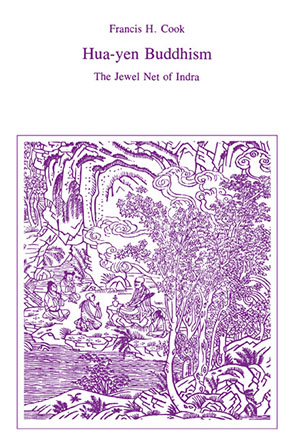
                Francis H. Cook, Hua-yen Buddhism: The Jewel Net of Indra
                Hua-yen is regarded as the highest form of Buddhism by most modern Japanese and Chinese scholars. This book is a description and analysis of the Chinese form of Buddhism called Hua-yen (or Hwa-yea), Flower Ornament, based largely on one of the more systematic treatises of its third patriarch. Hua-yen Buddhism strongly resembles Whitehead's process philosophy, and has strong implications for modern philosophy and religion. Hua-yen Buddhism explores the philosophical system of Hua-yen in greater detail than does Garma C.C. Chang's The Buddhist Teaching of Totality (Penn State, 1971). An additional value is the development of the questions of ethics and history. Thus, Professor Cook presents a valuable sequel to Professor Chang's pioneering work. The Flower Ornament School was developed in China in the late 7th and early 8th centuries as an innovative interpretation of Indian Buddhist doctrines in the light of indigenous Chinese presuppositions, chiefly Taoist. Hua-yen is a cosmic ecology, which views all existence as an organic unity, so it has an obvious appeal to the modern individual, both students and layman.


                Gassho, Jundo
                stlah
                Last edited by Jundo; 05-18-2026, 12:20 AM.
                ALL OF LIFE IS OUR TEMPLE

                Comment

                • Onkai
                  Dharma Transmitted Priest
                  • Aug 2015
                  • 3717

                  #9
                  Thank you, Jundo. I'll look into that book.

                  Gassho, Onkai
                  Sat lah
                  美道 Bidou (Beautiful Way)
                  恩海 Onkai (Merciful/Kind Ocean)
                  She/her
                  I will always have a lot to learn

                  Comment

                  • Keidô NR
                    Member
                    • Apr 2026
                    • 5

                    #10
                    It was very interesting indeed, thank you for organizing it ! I wasn't really aware of the Huayan influence as a school on Dogen and zen outside of the Indra's net (& outside of the use of the Avatamsaka Sutra in their own way) and it opens a lot of perspectives and things to dig in. What you quoted here:

                    Originally posted by Jundo
                    As Prof. Heine said, it is a teaching very influential on Zen and Dogen, both directly and indirectly. I often say things around here such as, "Each thing/being/moment of time is all things/beings/moments, and everything/being/moment, and each one thing/being/moment fully embodies every other thing/being/moment and the whole thing and all time, while simultaneously each and all are empty of individual thingness and time... ."
                    Is very close to the "Ichinen Sanzen" doctrine of the Tendai school in which Dogen was trained and which is centered on the Lotus Sutra ("Ichinen Sanzen/Three Thousand realities in a single moment of consciousness" was developed by Zhiyi based on the Lotus Sutra), thank you for pointing that it's a Huayan teaching at the same time, I never really made the link between the two schools !

                    Gassho
                    Keidô
                    Shô Zan - "Auspicious Mountain"
                    Kei Dô - "Joyful Way"

                    Comment

                    • Jundo
                      Treeleaf Founder and Priest
                      • Apr 2006
                      • 44503

                      #11
                      Originally posted by Keidô NR
                      Is very close to the "Ichinen Sanzen" doctrine of the Tendai school in which Dogen was trained and which is centered on the Lotus Sutra ("Ichinen Sanzen/Three Thousand realities in a single moment of consciousness" was developed by Zhiyi based on the Lotus Sutra), thank you for pointing that it's a Huayan teaching at the same time, I never really made the link between the two schools !
                      Hi Keido,

                      I feel that common insights like this run through various places in the Mahayana. Perhaps because the meditative experience and teachings lead people to common insights. Also, there are many cross influences. After all, the priests in these traditions were not practicing in isolation, and were certainly familiar with other Sutras and traditions. Then, Chan Buddhism incorporated influences from several sources. For example, this scholar says ...

                      Although there is no single, unified thesis of interconnectedness that all Chinese Buddhist schools endorse, these schools share a common aim: to reveal profound and pervasive connections among things across disparate ontological categories, from material objects and their properties to mental phenomena and spacetime. Within this expansive domain, each school develops its own characteristic relations: Tiantai's ju 具 and shi 是, Sanlun's dai 待, Huayan's ji 即 and ru 入, and Chan's bu-er 不二. Although the precise meanings of these proposed interrelationships require further examination, it is significant that all these interconnectedness theses share a common origin: each is a development of the Indian Buddhist doctrine of emptiness.

                      ...

                      Although both Tiantai and Huayan posit the “mutual identity” of all things, they interpret it differently: for Tiantai, as Kang (2024) interprets, it expresses the conventional identity of inherently nonseparate things, whereas for Huayan, as Priest (2015, 2018) and Kang (2025) show, it means that all things depend on each other for being what they are. Furthermore, although both Sanlun and Huayan endorse universal interdependence, they differ in kind: Ho (unpublished manuscript) interprets Sanlun's dependence as attributive—things depend on each other for having certain attributes—whereas Huayan's dependence is essential and thus existential, with things depending on each other both for their identity and their very existence.

                      Like Tiantai and Sanlun, the Huayan thesis of interconnectedness is predicated upon and advances from the doctrine of emptiness. Fazang suggests that the universal principle li 理, frequently identified as emptiness in Huayan texts,41 provides the ground for interconnectedness: “Each organ and hair-tip of the lion completely encompasses the lion through the gold.” Moreover, Chengguan's Huayan Fajie Xuanjing 華嚴法界玄鏡 (Mirror of the Mysteries of the Universe of the Huayan, T.45.1883)42 contains discussions for developing this argument through its progressive analysis of worldly things' (shi 事) dependence on li, li's dependence on worldly things, and the mutual dependence between worldly things. This potential philosophical reconstruction, however, calls for further conceptual elaboration and systematic development.43

                      ...

                      Chan practice is integrated with theories from Tiantai, Sanlun, and Huayan traditions. ... The two levels of nonduality echo the theses of interconnectedness in Tiantai, Sanlun, and Huayan. The transcendence of oppositions reflects Tiantai's dissolution and reconstruction of conceptual boundaries, whereas the Chan thesis of mutual dependence can be interpreted through either Sanlun or Huayan interdependence. While Ho's (2016) analysis of Chan interdependence parallels Ho's (unpublished manuscript) reconstruction of Jizang's interdependence thesis, the Huayan influence appears most explicitly in Chan Master Shitou Xiqian's 石頭希遷 (700–790 CE) poem Cantongqi 參同契 (Harmony of Difference and Sameness), which employs the characteristic Huayan language of interconnectedness ...

                      https://compass.onlinelibrary.wiley....111/phc3.70024
                      Gassho, J
                      stlah


                      ALL OF LIFE IS OUR TEMPLE

                      Comment

                      • Keidô NR
                        Member
                        • Apr 2026
                        • 5

                        #12
                        Thank you for your answer Jundo and for this very interesting paper ! Indeed it is my understanding as well that different schools express the same thing but with different "flavors" and that the schools never lived in a vacuum. I'm actually not so sure about Kang's explanation of Tiantai doctrine as it's different from what is taught in Japanese Tendai nowadays, but her analysis of the different schools is very impressive! It may also come from the fact that Tendai as Dogen trained in actually significantly differs from Chinese Tiantai as it's founders integrated teachings from other schools from the start and continued to do so as a core element of the "Ekayana/One Vehicle" principle (Saicho had actually received a Chan transmission as well, and I just discovered that his teacher's teacher actually brought Huayan teachings to Japan as well which might blur the boundaries even more!). I also love the fact that Chan influenced Tiantai & Tendai, which in turn influenced Chan & Zen, etc. in a never ending rotation of the Wheel .

                        Gassho,
                        Keidô
                        Shô Zan - "Auspicious Mountain"
                        Kei Dô - "Joyful Way"

                        Comment

                        Working...