Chants and chanting

Collapse
X
 
  • Time
  • Show
Clear All
new posts
  • michaelw
    Member
    • Feb 2022
    • 365

    Chants and chanting

    It looks as though the Chanting Circle is no longer practicing. Are there any plans to revive it or better still any Treeleaf or other recommended recordings that I can download to chant along with while I learn them? I have our Heart Sutra and Sandokai versions from the chant book is there a Sino Japanese version of Sandokai arranged line by line or a marked-up version I can edit to put in that format ?

    Gassho
    MichaelW
    satlah

  • Shujin
    Novice Priest-in-Training
    • Feb 2010
    • 1521

    #2
    Hi Michael, I don't know of any plans to revive the Chanting Circle, although one of our other priests may have more information. I found a version of the Sandokai that seems to be based at least in part off of Soto-shu's liturgy, and attached it below. There's an audio version on YouTube, but I'm hesitant to recommend it. I don't really know if the pronunciation is correct...

    Gassho,
    Shujin
    st/lah

    LINK REMOVED by JUNDO
    Last edited by Jundo; 01-31-2026, 12:00 AM.
    Kyōdō Shujin 教道 守仁

    Comment

    • michaelw
      Member
      • Feb 2022
      • 365

      #3
      Shujin
      Many thanks.

      Gassho
      MichaelW
      satlah

      Comment

      • Jundo
        Treeleaf Founder and Priest
        • Apr 2006
        • 44519

        #4
        Hi Michael,

        There is no present plan to revive the Chanting Circle, although it would always be nice if there is some interest.

        An interesting story about the Japanese Sandokai. The chanting version in Japanese is very constant and unchanging in beat and tone, with special accents that match long or extended syllables, in the Japanese style. So, Bernie Glassman spiced it up in English with an influence from ... Fiddler on the Roof (it is true! ). You can read about that more here:
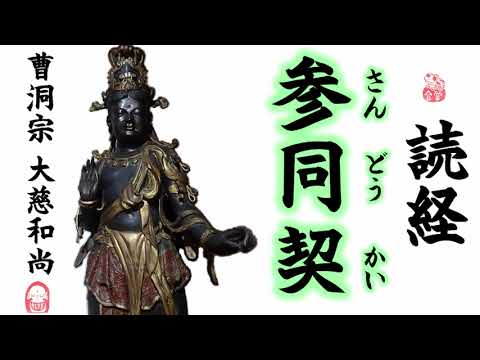
        The Sandokai is cherished in the Soto Zen tradition, both relatively and absolutely! Although probably not actually composed by the Third Zen Ancestor in China, Sekito (Shitou) as reputed, it is nonetheless a text of ultimate Wisdom, embodying our most fundamental Teachings and Practices. For more on its history, here is a


        Here is the formal Japanese version ...
        .
        Another Soto priest has a somewhat more lyrical version ...
        .

        I removed the link that Shujin put as the translation was a bit unusual. Here is the official Japanese version from Sotoshu.


        Line by line, it matches the Soto-shu English version (a little differently worded from ours), so you can see what each sentence means, line by line ...


        You can follow along with the above video to see how the Japanese priest recites it.

        Gassho, J
        stlah


        ALL OF LIFE IS OUR TEMPLE

        Comment

        • michaelw
          Member
          • Feb 2022
          • 365

          #5
          Thanks for that.
          The reason I asked for a Sino Japanese wrongly as it should have been romanji was to get away from those dreadful 'karaoke' versions that seem to hog the search engines. I thought if I could get recordings I could chant along whenever I had time.
          This was further complicated by a HAL9000 AI CoPilot telling me that the version that starts 'Chikudo daisan no shin' is not Sandokai but a Soto temple version and the English version that starts 'The mind of the Great Sage of India is intimately conveyed west and east.' is a western poetic version. I was/am trying to find the romanji version of this?

          Gassho
          MichaelW
          satlah

          Comment

          • Jundo
            Treeleaf Founder and Priest
            • Apr 2006
            • 44519

            #6
            'Chikudo daisan no shin' is not Sandokai but a Soto temple version and the English version that starts 'The mind of the Great Sage of India is intimately conveyed west and east.' is a western poetic version. I was/am trying to find the romanji version of this?
            I am not sure what you might mean by this. Can you clarify?

            Gassho, J
            stlah
            ALL OF LIFE IS OUR TEMPLE

            Comment

            • Bion
              Dharma Transmitted Priest
              • Aug 2020
              • 7110

              #7
              Originally posted by michaelw
              This was further complicated by a HAL9000 AI CoPilot telling me that the version that starts 'Chikudo daisan no shin' is not Sandokai but a Soto temple version and the English version that starts 'The mind of the Great Sage of India is intimately conveyed west and east.' is a western poetic version. I was/am trying to find the romanji version of this?

              Gassho
              MichaelW
              satlah
              Well, that's interesting. You can see in the Sotoshu Scriptures for daily practice that the English version starts with "The mind of the great sage..." and the Jap. transliteration available in the second half of the book is "Chikudo daisen no shin.." The Japanese text is 竺土大仙心 , which starts with 竺土 Chikudo which is classical chinese for bamboo land, or India, then 大仙 dai sen which is great sage, and then 心 shin, which is mind .. I'd say it's the same text

              Gassho
              sat lah


              Last edited by Bion; 01-31-2026, 02:24 PM.
              "One uninvolved has nothing embraced or rejected, has sloughed off every view right here - every one."

              Comment

              • Junsho
                Member
                • Mar 2024
                • 446

                #8
                Hi Michael,
                Perhaps we could consider having occasional special sessions. I asked our Roshi to end this group due to lack of quorum, since I was the only one participating. However, if others are interested in practicing, we can discuss ways to make that happen from time to time, similar to the Oryoki group. For now, please feel free to reach out to me via message, and I will do my best to support you.

                Gassho and deep bows.
                ​​​​​​SatLah
                Junshō 純聲 - Pure Voice, Genuine Speech

                Each time we fall asleep, we die; each time we wake, we are reborn.

                Comment

                • Jundo
                  Treeleaf Founder and Priest
                  • Apr 2006
                  • 44519

                  #9
                  I am not sure why, but the links to the Soto-shu version are a bit strange. So, here are the Japanese and English versions side by side ...

                  image.pngimage.png
                  ​​
                  Last edited by Jundo; 01-31-2026, 11:59 PM.
                  ALL OF LIFE IS OUR TEMPLE

                  Comment

                  • Chikyou
                    Member
                    • May 2022
                    • 1062

                    #10
                    For the Heart Sutra in Japanese, there’s an app called Heart Sutra 365. I’m really enjoying it! I think it’s exactly what you’re looking for - available on both iPhone and Android.

                    Gassho,
                    SatLah
                    Chikyō
                    Chikyō 知鏡
                    (Wisdom Mirror)
                    They/Them

                    Comment

                    • michaelw
                      Member
                      • Feb 2022
                      • 365

                      #11
                      Ok a little more clarification via two unreliable sources AI and my memory.
                      The argument/discussion I had with AI was because the text I had downloaded via Shujin and the text AI was giving me did not match. A cut and paste of the first lines from Shujin copy resulted in AI saying that is not how Sandokai starts and gave another version. AI also states that Soto Shu has a long and a short version with one being an Eno led call response format. This is where things get way above my experience where AI starts to tell me that romanji(?) is not fixed(?) but depends on local use (dialect?) thus knowing Sandokai in one format may not be the same format used elsewhere. I just asked again and this is its response:

                      The opening line of the Sandōkai in rōmaji is traditionally rendered as:

                      “Daishō chinden seishi tōrai.”

                      A more expanded, commonly chanted version is:

                      “Chikudo daisen no shin, tōzai mitsuni aisu.”

                      Different Zen lineages use slightly different romanizations, but those are the standard forms you’ll hear in Sōtō liturgy.


                      Is one Chinese as opposed to Japanese?
                      To try and force AI to give what I wanted I tried to upload the Treeleaf version only to find AI would not accept it as it is copyrighted and the same also seems to apply to other versions so AI cannot access them.
                      Any way let calm return. I have what need for now and I can use our Treelaf recordings to chant along for Heart sutra in which ever format plus Sandokai in English.
                      Thanks everyone for your help.

                      Gassho
                      MichaelW
                      satlah

                      Comment

                      • Jundo
                        Treeleaf Founder and Priest
                        • Apr 2006
                        • 44519

                        #12
                        Okay, long story short, and mystery partly solved I think. Here is the traditional Chinese version ... It is read top to bottom, right side to left:

                        image.png
                        The Kanji are identical to the Japanese version (except for small calligraphic differences between Japanese and Chinese, but otherwise the same Kanji.)

                        What is meant by two ways to chant it is (1) following Chinese grammar but with Japanese pronunciation, or (2) with both Japanese grammar and Japanese Pronunciation.

                        So, for example, if reading the first as if Chinese, but pronounced the Japanese way, it is ...

                        Chikudo daisen shin tōzai mitsu aifu

                        Adding the Japanese grammar elements (in parenthesis)

                        Chikudo daisen (no) shin, tōzai mitsu (ni) aifu (su)

                        To convey what is happening if it were English, in the first version as if Chinese ...

                        India Great Sage Mind East West Intimate Conveyed

                        ... and in the second version , with Japanese grammar elements in () ...

                        India Great Sage ('s possessive) Mind (is) East West (to) Intimately conveyed

                        The difference is just whether it is chanted with or without the (in parenthesis) Japanese grammar elements. Frankly, the grammar elements do not change the meaning and, in fact, add clarity often missing from the very "short hand, abbreviated" nature of Chinese writing.

                        So, in that case, what is "Daishō chinden seishi tōrai?" NOTHING!

                        There is no way that any Kanji there is to be found in any portion of the Sandokai, in either Chinese or Japanese, including in ancient Japanese pronunciations, in any way even close to "Daishō chinden seishi tōrai." Furthermore, in the TOTALLY UNRELATED Pure Land scriptures, "Seishi torai" may refer to the arrival or descent of the Bodhisattva Seishi (Sanskrit: Mahāsthāmaprāpta) from the Pure Land to welcome a dying person. Daisho Chinden seems untraceable. An internet search finds nothing connecting "chinden" and the Sandokai in any way. Maybe Daisho could be Daisho 大疏 (meaning "A great Sutra commentary") and Chinden might be 展轉 (meaning "in succession" or "to revolve" something.) Nothing else even close.

                        Strikes me as an AI hallucination.

                        Gassho, Jundo
                        stlah

                        PS - Two trivia facts: There is another, totally unrelated "Sandokai," a Taoist text on alchemy. Some people ponder if there is any relationship. (https://en.wikipedia.org/wiki/Cantong_qi) I don't think that "Daishō chinden seishi tōrai" is related to that one either.

                        Also, there is a long and short version of the Heart Sutra. The Tibetans chant the long version, which has an intro which sets the scene, and a big closing.

                        Thus have I heard. Once the Blessed One was dwelling in Rajagriha at Vulture Peak mountain, together with a great gathering of the sangha of monks and a great gathering of the sangha of bodhisattvas. At that time the Blessed One entered the samadhi that expresses the dharma called "profound illumination," and at the same time noble Avalokiteshvara, the bodhisattva mahasattva, while practicing the profound prajnaparamita

                        ... GATE GATE PARAGATE PARASAMGATE BODHI SVAHA Thus, Shariputra, the bodhisattva mahasattva should train in the profound prajnaparamita. Then the Blessed One arose from that samadhi and praised noble Avalokiteshvara, the bodhisattva mahasattva, saying, "Good, good, O son of noble family; thus it is, O son of noble family, thus it is. One should practice the profound prajnaparamita just as you have taught and all the tathagatas will rejoice." When the Blessed One had said this, venerable Shariputra and noble Avalokiteshvara, the bodhisattva mahasattva, that whole assembly and the world with its gods, humans, asuras, and gandharvas rejoiced and praised the words of the Blessed One.

                        Thus concludes the Sutra of the Heart of Transcendent Knowledge
                        Last edited by Jundo; 02-01-2026, 01:27 PM.
                        ALL OF LIFE IS OUR TEMPLE

                        Comment

                        • Onsho
                          Member
                          • Aug 2022
                          • 306

                          #13
                          Originally posted by Jundo
                          Hi Michael,

                          There is no present plan to revive the Chanting Circle, although it would always be nice if there is some interest.

                          An interesting story about the Japanese Sandokai. The chanting version in Japanese is very constant and unchanging in beat and tone, with special accents that match long or extended syllables, in the Japanese style. So, Bernie Glassman spiced it up in English with an influence from ... Fiddler on the Roof (it is true! ). You can read about that more here:

                          The Sandokai is cherished in the Soto Zen tradition, both relatively and absolutely! Although probably not actually composed by the Third Zen Ancestor in China, Sekito (Shitou) as reputed, it is nonetheless a text of ultimate Wisdom, embodying our most fundamental Teachings and Practices. For more on its history, here is a


                          Here is the formal Japanese version ...
                          .
                          Another Soto priest has a somewhat more lyrical version ...
                          .

                          I removed the link that Shujin put as the translation was a bit unusual. Here is the official Japanese version from Sotoshu.


                          Line by line, it matches the Soto-shu English version (a little differently worded from ours), so you can see what each sentence means, line by line ...


                          You can follow along with the above video to see how the Japanese priest recites it.

                          Gassho, J
                          stlah


                          That first version gives me chills.... delightful.
                          The hiragana added to the second video is really handy too. These are great finds.

                          Gassho
                          Onsho
                          satlah

                          Comment

                          • Onki
                            Novice Priest-in-Training
                            • Dec 2020
                            • 1321

                            #14
                            Originally posted by Chikyou
                            For the Heart Sutra in Japanese, there’s an app called Heart Sutra 365. I’m really enjoying it! I think it’s exactly what you’re looking for - available on both iPhone and Android.

                            Gassho,
                            SatLah
                            Chikyō
                            This is a great app!!

                            Gasshō,

                            On

                            sat/lah
                            “Let me respectfully remind you
                            Life and death are of supreme importance.
                            Time swiftly passes by
                            And opportunity ist lost.
                            Each of us should strive to awaken.
                            Awaken, take heed,
                            Do not squander your life.​“ - Life and Death and The Great Matter

                            Comment

                            Working...