Dear All,
The Rev. Shinshu Roberts, Soto Zen Priest and co-founder of the Ocean Gate Zen Center, as well as the author of wonderful books on Master Dogen, including the recently released Meeting the Myriad Things: A Zen Practitioner’s Guide to Dogen’s Genjokoan (LINK) and her earlier Being-Time on Shobogenzo-Uji (LINK) is coming to Treeleaf as a Guest Teacher on Sunday, October 19th! Here is a little more about her:
Shinshu Roberts is a Dharma Heir of Sojun Mel Weitsman, abbot of Berkeley Zen Center and in the lineage of Shunryu Suzuki Roshi. She received her priest training at San Francisco Zen Center and from the North American branch of the Japanese Soto School. She has been appointed Kokusaifukyoshi (International Dharma Teacher) by the Shumucho (Japanese Soto Administration). She co-founded Ocean Gate Zen Center in Capitola, CA with her spouse Jaku Kinst. ... In her commentaries on Dogen Zenji's teachings it is her intention to bring these teachings into our contemporary dialogue about how we practice Zen. Practicing Zen is based upon manifesting our basic nature as being already endowed with buddha nature; as is all of reality. Nevertheless, it is difficult for us to go beyond our delusion and conflict to bring forth our compassion and wisdom for and with all beings that make our world. Dogen's teachings guide us in our vow to benefit all, not just the self.
Her Talk will reflect on her new book on Genjo-Koan: Meeting the Myriad Things.
A guide to awakening buddha mind for the contemporary Zen practitioner.
In the words of Eihei Dōgen, the thirteenth-century Buddhist monk who introduced the Sōtō school of Zen to Japan, “To study the Buddha way is to study the self. To study the self is to forget the self. To forget the self is to be actualized by myriad things.” Centuries later, these enigmatic words from his seminal “Genjōkōan” (“Actualizing the Fundamental Point”) are still studied in Zen communities the world over.
But what did Dōgen really mean when he encouraged studying the self to forget the self? In this clarifying new commentary, esteemed Zen teacher Shinshu Roberts takes readers on a journey to understand Japan’s great Buddhist philosopher. Roberts applies her deep familiarity with Dōgen’s work to illuminate the text as a unified story in which Dōgen reveals the nondual nature of reality.
In addition to a full translation of Dōgen’s “Genjōkōan,” this book includes the commentary Okikigakishō (“Notes of What Was Heard and Extracted”), written by two of Dōgen’s direct students—the first time an English translation of this highly influential work has appeared in print.
In the words of Eihei Dōgen, the thirteenth-century Buddhist monk who introduced the Sōtō school of Zen to Japan, “To study the Buddha way is to study the self. To study the self is to forget the self. To forget the self is to be actualized by myriad things.” Centuries later, these enigmatic words from his seminal “Genjōkōan” (“Actualizing the Fundamental Point”) are still studied in Zen communities the world over.
But what did Dōgen really mean when he encouraged studying the self to forget the self? In this clarifying new commentary, esteemed Zen teacher Shinshu Roberts takes readers on a journey to understand Japan’s great Buddhist philosopher. Roberts applies her deep familiarity with Dōgen’s work to illuminate the text as a unified story in which Dōgen reveals the nondual nature of reality.
In addition to a full translation of Dōgen’s “Genjōkōan,” this book includes the commentary Okikigakishō (“Notes of What Was Heard and Extracted”), written by two of Dōgen’s direct students—the first time an English translation of this highly influential work has appeared in print.
It can also be viewed "one way" at the time, or later, at the following screen:
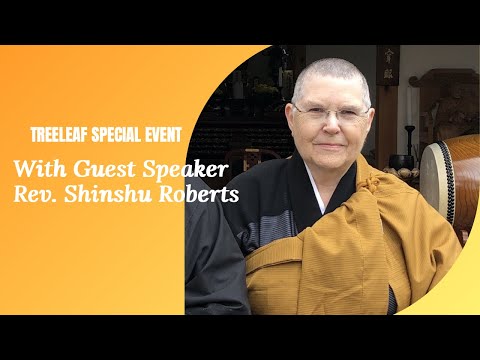
There will be a Q&A after her talk, at which you can either ask a LIVE question, or email me a question which I will read (email your question to Jundotreeleaf[a]gmail.com)
I would really appreciate a BIG TREELEAF TURNOUT for this event, and I assure you that it will be worth your time to attend.
DONATION:
The event is free, but we ask those who can afford to make a voluntary donation, whatever you might afford and feel's right, to her Sangha, the Ocean Gate Zen Center, which they work hard to maintain, via this link at their web page (please indicate that Treeleaf sent ya, and it is for this event
 ):
):.
Thank you.

Shinshu's books are AMAZING and I cannot recommend highly enough as introductions and gateways to the writings of Master Dogen.
.
image.png
Gassho, Jundo
stlah

Comment