Whattsa Who'sa Bodhisattva? - Manjushri
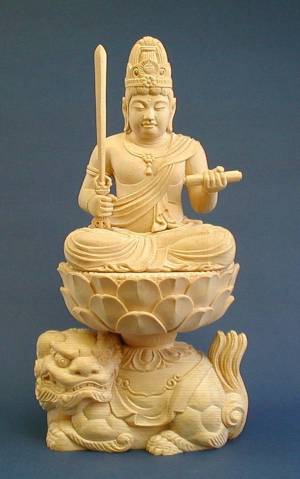
Each of the Bodhisattvas may be seen as an archetype for a vital aspect of Buddhist Practice ... Manjushri Bodhisattva for Wisdom. Taigen Dan Leighton writes in FACES OF COMPASSION ...
Each of the Bodhisattvas may be seen as an archetype for a vital aspect of Buddhist Practice ... Manjushri Bodhisattva for Wisdom. Taigen Dan Leighton writes in FACES OF COMPASSION ...
Manjushri is the bodhisattva of wisdom and insight, penetrating into the fundamental emptiness, universal sameness, and true nature of all things. Manjushri ... sees into the essence of each phenomenal event. This essential nature is that not a thing has any fixed existence separate in itself, independent from the whole world around it. The work of wisdom is to see through the illusory self-other dichotomy, our imagined estrangement from our world. Studying the self in this light, Manjushri's flashing awareness realizes the deeper, vast quality of self, liberated from all our commonly unquestioned, fabricated characteristics.
... Manjushri cuts through our conventional conceptions of and attachments to abiding, increase and decrease, ordinary and holy, nirvana and samsara, arising and ceasing, aspiring, and grasping. Experiencing personally and clearly the perfection of wisdom that Manjushri expounds is about seeing through, and being liberated from, all limited views about these common snares of consciousness. (Bodhisattva Archetypes, p. 93 & 116)
... Manjushri cuts through our conventional conceptions of and attachments to abiding, increase and decrease, ordinary and holy, nirvana and samsara, arising and ceasing, aspiring, and grasping. Experiencing personally and clearly the perfection of wisdom that Manjushri expounds is about seeing through, and being liberated from, all limited views about these common snares of consciousness. (Bodhisattva Archetypes, p. 93 & 116)



 However, the origins of this popular "Laughing Buddha" are actually found a figure called Hotei from China, a jolly fat monk who happened to be a devotee of Maitreya, and whose image became mixed into the Maitreya legend over time. In any event, even if not really "Maitreya", the image is very popular in Chinese Buddhist temples ... and Chinese restaurants. One popular belief is that if one rubs his fat belly on the 1st day of the Lunar Year, it will bring forth wealth, good luck and prosperity.

Comment