Stories of the Lotus Sutra - Chapter 3: The Dharma Flower Assembly

Collapse
X
 
  • Time
  • Show
Clear All
new posts
  • Bion
    Senior Priest-in-Training
    • Aug 2020
    • 6974

    Stories of the Lotus Sutra - Chapter 3: The Dharma Flower Assembly

    buddha flowers 3.jpg This week, we turn to a new chapter in Reeves’ book. I invite you to read it slowly, take notes if you wish, and give yourself time to sit with your thoughts. Some of the material may feel repetitive, but try not to let that distract you.

    Reading assignment: Chapter 3 - The Dharma Flower Assembly

    After you’ve reflected on the reading, please join the discussion here and share your insights with the group. You’re welcome to use the suggested questions on our Study Page, or create your own based on what stood out to you.

    As in previous weeks, I invite you to close by naming one thing you’ve learned from this chapter and posing one question about it—whether or not it has a clear answer. If you’d like, you can also visit the Study Page to watch our second Book Club meeting from this past Saturday. Have fun!

    Gassho
    sat lah
    Last edited by Bion; 02-16-2026, 07:48 PM.
    "One uninvolved has nothing embraced or rejected, has sloughed off every view right here - every one."
  • Maro
    Member
    • Dec 2025
    • 59

    #2
    Hello friends! If you find that I have deviated way too much, please bestow your patience on my post :-)

    I can’t help comparing the response I had when I first encountered the Lotus Sutra with the way I relate to it now that I come to meet it again. At first what picked my attention was Martin’s discussion on imagination. But then, all my reflections seem to have centered and settled on what I could call the koan of my life: the karmic consciousness.


    Case 37 from the Book of Equanimity keeps coming to mind where Yangshan says that because one hesitates with the question “what is it?”is the validation of the claim that all sentient beings just have karmic consciousness, boundless, unclear and disorienting (and there’s not even any foundation to rely on).

    Okumura Roshi, in the first chapter of his Mountains and Waters Sutra refers to the karmic consciousness as what gets in the way of encountering the text rather than understanding it. Okumura Roshi says that we want to understand and he goes on to say that this thirst to understand is a desire. And he encourages us, like Master Dogen to “do not-understanding”(fu-e in Japanese). According to Okumura Roshi we are to keep something in mind without grasping it with our personal “understanding”. In other words not grasping things with our karmic consciousness or with the thoughts that arise from it. This opening the hand of thought, as Okumura Roshi puts it, is the true Dharma eye.

    And then he goes on, so beautifully as I see it, to relate all this process of all eight layers of consciousness to the practice of zazen. For me the Yogacara explanation remains the most clear and helpful teaching I have encountered because it puts everything in a perspective I can comprehend and practice with without getting irrevocably lost.

    As to naming one thing I have learned that is the depth of my grasping to karmic consciousness which means that (paraphrasing Okumura Roshi) “whenever I encounter a new object or situation, I interpret it according to what kind of seeds are stored in my storehouse”.
    As for the question that for me would be the most helpful and appropriate to remember, I settled on Yangshan’s “what is it?”(from case 37)

    Gassho
    Maro
    satlah

    Comment

    • Bion
      Senior Priest-in-Training
      • Aug 2020
      • 6974

      #3
      Originally posted by Maro
      Hello friends! If you find that I have deviated way too much, please bestow your patience on my post :-)

      I can’t help comparing the response I had when I first encountered the Lotus Sutra with the way I relate to it now that I come to meet it again. At first what picked my attention was Martin’s discussion on imagination. But then, all my reflections seem to have centered and settled on what I could call the koan of my life: the karmic consciousness.


      Case 37 from the Book of Equanimity keeps coming to mind where Yangshan says that because one hesitates with the question “what is it?”is the validation of the claim that all sentient beings just have karmic consciousness, boundless, unclear and disorienting (and there’s not even any foundation to rely on).

      Okumura Roshi, in the first chapter of his Mountains and Waters Sutra refers to the karmic consciousness as what gets in the way of encountering the text rather than understanding it. Okumura Roshi says that we want to understand and he goes on to say that this thirst to understand is a desire. And he encourages us, like Master Dogen to “do not-understanding”(fu-e in Japanese). According to Okumura Roshi we are to keep something in mind without grasping it with our personal “understanding”. In other words not grasping things with our karmic consciousness or with the thoughts that arise from it. This opening the hand of thought, as Okumura Roshi puts it, is the true Dharma eye.

      And then he goes on, so beautifully as I see it, to relate all this process of all eight layers of consciousness to the practice of zazen. For me the Yogacara explanation remains the most clear and helpful teaching I have encountered because it puts everything in a perspective I can comprehend and practice with without getting irrevocably lost.

      As to naming one thing I have learned that is the depth of my grasping to karmic consciousness which means that (paraphrasing Okumura Roshi) “whenever I encounter a new object or situation, I interpret it according to what kind of seeds are stored in my storehouse”.
      As for the question that for me would be the most helpful and appropriate to remember, I settled on Yangshan’s “what is it?”(from case 37)

      Gassho
      Maro
      satlah
      This makes me think of what I always say: wherever we turn, we run into ourselves. To me, this simply means that vigilance is important, because we filter the world—and our experiences of it—through our perceptions, which are shaped by previous causes and conditions that have planted seeds in our consciousness.

      In his fascicle *Shizen Bhikkhu*, Dōgen Zenji specifically says that the notion of innate knowledge—some kind of wisdom from birth, which Confucius proposed—goes against the Dharma, which teaches causality. He says, “In the Buddhadharma, there is no teaching that denies causality.”

      Thank you, Maro, for always pondering things so deeply!

      Gassho
      Last edited by Bion; 02-17-2026, 12:17 PM.
      "One uninvolved has nothing embraced or rejected, has sloughed off every view right here - every one."

      Comment

      • Tenryu
        Member
        • Sep 2025
        • 243

        #4
        Reading this chapter, I stayed with how Reeves unfolds the many meanings of dharma. Not as a definition to master, but as a widening field. Things as they appear, teaching, truth, and the reality that sustains all things together. It felt like a quiet reminder that practice does not point in only one direction, but touches everything at once.

        What lingered for me was the way the stories are said to persuade us that the bodhisattva life is not reserved for special beings. The invitation feels direct and ordinary. Not heroic, not abstract, but close to how life already asks something of us. Reeves’ emphasis that the concern of the Lotus Sutra extends beyond the human made this feel wider and quieter, as if responsibility is already implied by being here.

        I noticed how much attention he gives to the senses. Light, sound, scent, movement. The Dharma is not received only through thought, but through the whole body. Hearing it, sharing it, and living it are closely connected. The falling of flowers on everyone, including the Buddha, read as an image of equality rather than a statement about fixed roles makes sense to me.

        What stayed with me most was the emphasis on the Dharma being carried forward through ordinary actions in ordinary places. Classrooms, homes, workplaces, daily encounters. This did not feel like a new idea, but more like a quiet confirmation of something already familiar, put into words again and held up for a moment.

        One thing I’ve learned from this chapter:
        Not something new, but a clearer articulation of how dharma shows up everywhere, not apart from ordinary life.

        One question I would ask:
        What is already functioning here?

        Gasshō,
        Tenryū
        sat&lah

        恬流 - Tenryū - Calm Flow

        Comment

        • Hosui
          Member
          • Sep 2024
          • 234

          #5
          What, ironically, seems more straightforward in the Sutra itself — distinct to Gene’s gentle encouragement in Stories — is the paradox of its claim to reveal an ultimate truth that’s conveyed only by the expedient means of stories: it’s like a piece of IKEA furniture that we have to imaginatively assemble ourselves, minus the instructions, to interpret this ultimate truth. I’m okay with that as I know the work we have to do is right here in this very/every/any moment. But it’s odd when Gene, on page 34 of Stories, urges us to think critically and creatively about what has been said in the Sutra, but then does our thinking for us on page 37 by claiming that the three vehicles represent a means-end relation — the end as following the bodhisattva way — thereby dismissing the 3 vehicles, each of which seems to get equal billing as a valid path to buddhahood in the Sutra. I’m a committed fan of bodhisattvahood, don’t get me wrong, agreeing with Tenryu about its non-exclusiveness, and I could’ve misunderstood Gene; but spending time again with the Sandokai and Nagarjuna last week it seems Gene is rehearsing a hierarchy that subordinates conventional truth to ultimate truth when the Sutra appears to establish an equivalent value and ultimacy to both. I know it’s heretical in these Treeleaf halls, but I prefer the Tiantai’s introduction of a third truth which represents this equivalency; this ‘gooseberry’ truth being that there’s no means-end hierarchy to conventional and ultimate truth appearing as two separate claims, but instead two alternate restatements of the same fact — which is back to where we have our work cut-out in the here and now as perpetual bodhistattvas. The position of this third truth is where discriminations, preferences, distinctions, where this or that are both right/wrong/not right/not wrong. This seems like home turf to me.

          One thing learned: that bodhisattvahood is both a big deal and my daily life.
          One question I'd ask: I know it's jumping ahead, but are there three vehicles or just one, or are there four, or are these distinctions just the result of discriminative thought and interdependent co-arising?

          Gassho
          Hosui
          sat/lah today

          Comment

          • Bion
            Senior Priest-in-Training
            • Aug 2020
            • 6974

            #6
            Originally posted by Hosui
            What, ironically, seems more straightforward in the Sutra itself — distinct to Gene’s gentle encouragement in Stories — is the paradox of its claim to reveal an ultimate truth that’s conveyed only by the expedient means of stories: it’s like a piece of IKEA furniture that we have to imaginatively assemble ourselves, minus the instructions, to interpret this ultimate truth. I’m okay with that as I know the work we have to do is right here in this very/every/any moment. But it’s odd when Gene, on page 34 of Stories, urges us to think critically and creatively about what has been said in the Sutra, but then does our thinking for us on page 37 by claiming that the three vehicles represent a means-end relation — the end as following the bodhisattva way — thereby dismissing the 3 vehicles, each of which seems to get equal billing as a valid path to buddhahood in the Sutra. I’m a committed fan of bodhisattvahood, don’t get me wrong, agreeing with Tenryu about its non-exclusiveness, and I could’ve misunderstood Gene; but spending time again with the Sandokai and Nagarjuna last week it seems Gene is rehearsing a hierarchy that subordinates conventional truth to ultimate truth when the Sutra appears to establish an equivalent value and ultimacy to both. I know it’s heretical in these Treeleaf halls, but I prefer the Tiantai’s introduction of a third truth which represents this equivalency; this ‘gooseberry’ truth being that there’s no means-end hierarchy to conventional and ultimate truth appearing as two separate claims, but instead two alternate restatements of the same fact — which is back to where we have our work cut-out in the here and now as perpetual bodhistattvas. The position of this third truth is where discriminations, preferences, distinctions, where this or that are both right/wrong/not right/not wrong. This seems like home turf to me.

            One thing learned: that bodhisattvahood is both a big deal and my daily life.
            One question I'd ask: I know it's jumping ahead, but are there three vehicles or just one, or are there four, or are these distinctions just the result of discriminative thought and interdependent co-arising?

            Gassho
            Hosui
            sat/lah today
            The sutra begins by stating that all three vehicles are valid, each representing a different path to be chosen. Imagine that in very early Buddhism, including the beginnings of Mahayana, monks of different inclinations lived and practiced together. Mahayana was a belief system, not an ordination lineage. Everyone was ordained according to the Vinaya, whether it was the Pali, Mūlasarvāstivāda, or Dharmaguptaka tradition. A teacher might be dedicated to the Śrāvaka path while an ordained student pursued the Bodhisattva path. The Bodhisattva path was also not for everyone, and in proto-Mahayana times it was not even encouraged for most. It was reserved for truly determined practitioners who were willing to undertake the strictest observance of the Vinaya and dhūtaṅgas, and who were prepared to be reborn an unimaginable number of times before their opportunity to become a Buddha would finally come.

            The Lotus Sūtra starts from this context and, over time, proceeds to a complete rejection of the other two vehicles.

            gassho
            sat lah
            "One uninvolved has nothing embraced or rejected, has sloughed off every view right here - every one."

            Comment

            • Ryūdō-Liúdào
              Member
              • Dec 2025
              • 140

              #7
              A little late to the party, but I’ve caught up! Thank you for setting this up, Bion.

              In this chapter, the point that teachers are also students really clicked with me.
              We often assume that experience means someone “knows,” but that’s clearly not so. A child often teaches their parent things just through their own interest in, say… dinosaurs, and suddenly the roles flip hahaha.

              It reminds me that wisdom and ignorance aren’t fixed traits. They shift depending on the situation and subject. Someone can be deeply knowledgeable in one area and completely lost in another.

              So it feels important to stay open, neither pretending to be empty, nor clinging to being full. Just a teacup that can still receive more tea.

              So, when we see a teacher, bow.
              When we see a student, bow.
              When we see ourselves, bow twice… once for what we know, and once for what we will soon discover we didn’t.

              One thing I’ve learned from this chapter:
              Honestly, I’m not sure I learned anything new here. It felt more like gentle reminders of things I’ve sensed before, yet often forget.

              One question I would ask:
              Who is it that truly sits on the Peak... the teacher, the student, or something beyond both?

              Gasshō,
              流道 – Ryūdō – Liúdào
              Satlah

              Comment

              • Hokuu
                Member
                • Apr 2023
                • 205

                #8
                I know it’s heretical in these Treeleaf halls, but I prefer the Tiantai’s introduction of a third truth which represents this equivalency; this ‘gooseberry’ truth being that there’s no means-end hierarchy to conventional and ultimate truth appearing as two separate claims, but instead two alternate restatements of the same fact — which is back to where we have our work cut-out in the here and now as perpetual bodhistattvas. The position of this third truth is where discriminations, preferences, distinctions, where this or that are both right/wrong/not right/not wrong.
                Hm, I thought this was the "Treeleaf orthodox" understanding. Isn't it what we sing in the Sandokai?
                Or are we the "fourth truth" guys stepping beyond non-discrimination and finding ourselves gasping in awe, rediscovering how in the end "mountains are mountains and rivers are rivers"?

                gassho
                satlah
                歩空​ (Hokuu)
                歩 = Walk / 空 = Sky (or Emptiness)
                "Moving through life with the freedom of walking through open sky"

                Comment

                • Bion
                  Senior Priest-in-Training
                  • Aug 2020
                  • 6974

                  #9
                  Originally posted by Hosui
                  I know it’s heretical in these Treeleaf halls, but I prefer the Tiantai’s introduction of a third truth which represents this equivalency; this ‘gooseberry’ truth being that there’s no means-end hierarchy to conventional and ultimate truth appearing as two separate claims, but instead two alternate restatements of the same fact — which is back to where we have our work cut-out in the here and now as perpetual bodhistattvas. The position of this third truth is where discriminations, preferences, distinctions, where this or that are both right/wrong/not right/not wrong. This seems like home turf to me.
                  I don’t know where you got the idea of heresy within Treeleaf from! The only heresy is disliking Jundo’s singing when he bursts into song during zazenkai!

                  Whether one defines this in terms of one, two, three or four truths, it´s just concepts trying to encapsulate the whole. The Buddha never spoke in different terms regarding an ultimate reality and a relative one, or a mixture of them. He flowed freely between persons, objects or phenomena when teaching.

                  The Sandokai, as we have mentioned before, which Hokuu is also pointing to, precisely says that's they're not one, not two, like the foot before and the foot behind in walking... is there the reality of the left foot and the reality of the right foot, or is there the reality of feet in walking, which at times are left and right, others right and left, but they're just action? Which one is it? Yes

                  gassho
                  sat lah
                  Last edited by Bion; 02-18-2026, 06:56 PM.
                  "One uninvolved has nothing embraced or rejected, has sloughed off every view right here - every one."

                  Comment

                  • Tensei
                    Member
                    • Dec 2016
                    • 109

                    #10
                    After dragging myself out of a few rabbit holes (the closest thing I can find to mandarava flowers are spider lilies; however, I can’t seem to find any information on differentiating mandarava from manjushaka, let alone GREAT varietals… maybe they’re just bigger),

                    image.png

                    I found myself drawn to the discussion of equality in this chapter.

                    Reeves mentions equality in a few sections with the Dharma rain, the falling flowers, the four assemblies. The teachings are for everyone: man, woman, centaur, children of the heavens.

                    When looking at the corresponding chapter in the Sutra, I was amazed that the assembly of nuns was explicitly mentioned, only second to the assembly of monks and even before the bodhisattvas. When King Ajatashatru is included at the end of the list, it’s explicitly stated that he’s the son of Queen Vaidehi. After that, everyone is included in the four groups. It’s incredibly heartening to see the intentional inclusion of women as equals in teachings from (at least) 1500 years ago.

                    As Reeve’s points out on p. 36, we’re part of this great assembly, too.

                    I also enjoyed the reminder of what is meant by d/Dharma on p. 31, though I have the friendly ghost (memory) of Bion from early precept discussions to draw on for this, too. I was going to ask which of the three definitions the ‘Dharma’ of the Dharma Flower Sutra falls under, but I think it must be (2) through (4). I’m not sure how it would be (1), but perhaps the physical book fills that role.

                    So, one thing I learned from this chapter is enthusiasm for the teachings is essential, but should tempered with understanding and practice. My question may be more about the Sutra than the commentary, but what were the categories used to ‘split’ the four groups? Monks + Nuns, Bodhisattvas, Mystical Beings and King Ajatashatru? Also, I hope Reeves discusses him in greater detail later in the Commentary.

                    Gassho,
                    Tensei
                    satlah

                    Comment

                    • Jundo
                      Treeleaf Founder and Priest
                      • Apr 2006
                      • 44311

                      #11
                      If anyone would like to see a good-hearted and certainly sincere and very devout Chinese animation of this part of the Lotus Sutra (with English subtitles), well ... the following depicts Chapters 1 thru 4.

                      Apparently made about 15 years ago or more, long before AI, and probably on a very small budget, yes it is a bit (a lot) worshipful and maybe even too cute, but I think they did a fine job with limited resources in capturing such a fantastic story ...
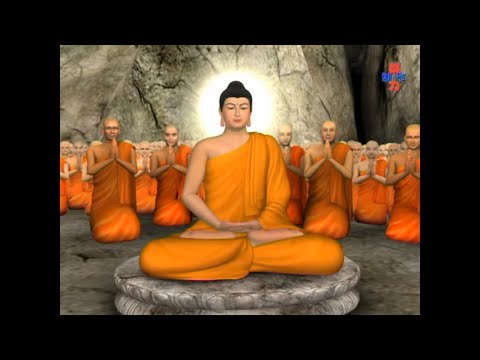
                      There are aspects of Buddhism that, if taken literally, would certainly rival those other religions with their "walking on water" and "burning bushes" and such.
                      .
                      Chapter 1 is the first 5 minutes.


                      Gassho, J
                      stlah
                      Last edited by Jundo; 02-20-2026, 02:09 AM.
                      ALL OF LIFE IS OUR TEMPLE

                      Comment

                      • MikeH
                        Member
                        • Aug 2025
                        • 37

                        #12
                        What struck me most was the great line, "the Buddha begins with an assembly." I take it Reeves intends this line literally and metaphorically. The story literally begins with Buddha in the midst of an assembly, but also, the Dharma is presented essentially as a teaching about relationship, connectedness, unity in the midst of difference, equality in the midst of apparent hierarchy, closeness despite cosmic distances, and so on. This really stayed with me.

                        What I learned: that critical thinking is welcome and even necessary in approaching the Dharma and this particular Sutra. My impressions from my previous reading have led me to think I needed to silence the critical aspect of my thinking in order to acquire "beginner's mind." I'm sure there's a happy medium, as always.

                        A question: how do we understand the "missionary" dimension of Buddhism that Reeves briefly mentions, and that he claims the Lotus Sutra is emphasizing? I have an allergy to missionary religious activity that seeks to convert, compel, convince, etc. I'm more of a worship-and-let-worship type of guy, so I'm eager to learn more about this. My sense from the Sutra itself and from Reeves is that this Buddhist missionary activity is more of invitation and wholesome living than it is preaching on street corners and leaving Sutras in motel room bedside tables. But maybe I'm naive...

                        gassho
                        satlah
                        Mike
                        Last edited by MikeH; 02-20-2026, 03:42 PM.

                        Comment

                        • Chikyou
                          Member
                          • May 2022
                          • 1048

                          #13
                          Originally posted by MikeH

                          A question: how do we understand the "missionary" dimension of Buddhism that Reeves briefly mentions, and that he claims the Lotus Sutra is emphasizing? I have an allergy to missionary religious activity that seeks to convert, compel, convince, etc. I'm more of a worship-and-let-worship type of guy, so I'm eager to learn more about this. My sense from the Sutra itself and from Reeves is that this Buddhist missionary activity is more of invitation and wholesome living than it is preaching on street corners and leaving Sutras in motel room bedside tables. But maybe I'm naive...

                          gassho
                          satlah
                          Mike
                          I’m probably not the best person to answer this question but it piqued my interest so I’ll give my own impression - to me, the “missionary” dimension of Buddhism is compassion, it’s saving beings, it’s sharing the Dharma in ways that are relevant to the particular beings you’re interacting with. In the Parable of the Plants (which we may or may not have gotten to yet - I am finding that Reeves’ commentary is not very straight forward and seems to be mixing bits of the sutra parables with chapter after chapter of introduction to the stories) the Buddha speaks of the Dharma rain which falls on every plant and waters each according to their needs. In my mind, the Dharma is for everyone, and the Dharma which is for, say, a Christian, doesn’t require them to give up their Christian beliefs in order to benefit from it. In this way, we’re not converting anyone, merely planting seeds of the Dharma which take root and grow, easing suffering wherever they happen to bloom.

                          Gassho,
                          SatLah,
                          Chikyō
                          Chikyō 知鏡
                          (Wisdom Mirror)
                          They/Them

                          Comment

                          • Shujin
                            Novice Priest-in-Training
                            • Feb 2010
                            • 1486

                            #14
                            This chapter was a bit more concrete than the previous two. Reeves writes about the challenges of using the word "dharma" (well, it's not always challenging, but can be). As he says, Buddhism is for all living beings (Dogen would also add trees, rocks, mountains waters, etc). He goes on to write: "For the Dharma Flower Sutra to be accepted by modern people, it has to be carefully taught and explained, event criticized in terms that people can understand."

                            On page 35, these words fit the mission of Treeleaf rather well: "We should also recognize that each preacher or teacher of the Dharma must be so in his or her smaller world, be it at a university, a business, a playground, a home or whatever. There are buddhas in temples to inspire us, but what the Dharma demands of us is that it be shared, taught, and embodied everywhere, that is, wherever we are."

                            The chapter closes with an imperative: the Dharma Flower Sutra exists not only to help us, but to place demands and responsibilities as well.

                            MikeH Your question about missionary work depends mostly upon the sect of school of Buddhism one follows. In our Soto world, we tend to align with what you're describing. Other groups, such as Soka Gakkai, are the polar opposite.

                            Gassho,
                            Shujin
                            st/lah
                            Kyōdō Shujin 教道 守仁

                            Comment

                            • Bion
                              Senior Priest-in-Training
                              • Aug 2020
                              • 6974

                              #15
                              Originally posted by MikeH
                              A question: how do we understand the "missionary" dimension of Buddhism that Reeves briefly mentions, and that he claims the Lotus Sutra is emphasizing? I have an allergy to missionary religious activity that seeks to convert, compel, convince, etc. I'm more of a worship-and-let-worship type of guy, so I'm eager to learn more about this. My sense from the Sutra itself and from Reeves is that this Buddhist missionary activity is more of invitation and wholesome living than it is preaching on street corners and leaving Sutras in motel room bedside tables. But maybe I'm naive...

                              gassho
                              satlah
                              Mike
                              Hey Mike, context is very important here.

                              Back in the earliest phase of Mahayana development, and later as well, bodhisattvas were strongly encouraged to speak about the Dharma or teach it to all beings without discrimination, and by any (right) means necessary.

                              For example, an early Mahayana sutra says that, “in whatever village, town, city, kingdom, or capital the bodhisattva may dwell, there he should pronounce a Dharma talk, and those who have no faith he should induce to have faith.”

                              The *Brahma Net Sutra* has a minor precept (no. 45) that says (and I don’t like this translation, but the message is the same) that a bodhisattva “should always invoke the mind of great compassion. When one enters a city or home, one should say to people, ‘You should take the Three Refuges and accept the ten [Bodhisattva] precepts.’ When one sees animals, such as cows, horses, pigs, or goats, one should speak one’s mind, saying to them, ‘You animals should activate the bodhi mind.’ When a bodhisattva crosses mountain forests, rivers, or wilderness, he should enable all sentient beings to activate the bodhi mind. If a bodhisattva fails to teach and transform sentient beings, it is a minor sin.”

                              As with many things, one needs to use wisdom in interpreting these passages, because teaching beings can be done verbally, bodily, and mentally. Verbal teaching is considered the least effective, by the way. Through one’s bodily actions, one can truly be an example of the good medicine that the Dharma is. Nevertheless, the duty of the bodhisattva is to free all beings, by any and all skillful means.

                              It might be helpful to us to remember that teaching the Dharma does not depend on specific words or concepts. The Way is simply living our lives with the mind of a buddha, expressed through our ordinary actions. To teach someone the Dharma does not require us to announce “the good news about the Buddha.” Instead, we might understand “missionary work” in a different light, without comparing it to Christian models, for example.

                              gassho
                              sat lah
                              Last edited by Bion; 02-22-2026, 10:18 AM.
                              "One uninvolved has nothing embraced or rejected, has sloughed off every view right here - every one."

                              Comment

                              Working...