This is a public announcement of our annual Jukai (Undertaking the Precepts) preparations
and Ango (Dedicated Practice Season) at Treeleaf.
All are welcome, but registration with our Forum is necessary
for access to all resources and links, as our activities are in a private area.
If wishing to participate, or if you have a question, please write me at jundotreeleaf@gmail.com
and Ango (Dedicated Practice Season) at Treeleaf.
All are welcome, but registration with our Forum is necessary
for access to all resources and links, as our activities are in a private area.
If wishing to participate, or if you have a question, please write me at jundotreeleaf@gmail.com
.
Kanji "Kai" meaning "Precept"

.
THE TIME FOR ...
.
THE TIME FOR ...
Treeleaf Sangha's.
EIGHTEENTH “JUKAI”
HAS ARRIVED!
EIGHTEENTH “JUKAI”
HAS ARRIVED!
Dear All,
"Jukai" means "Undertaking the Precepts." Here is a little information on generally what it entails and who may join in. More detailed information is available inside our Forum:
Each week, we will study together, and reflect upon, various short readings about the Precepts from a variety of Zen and other Buddhist teachers, all available online. (No book purchase will be required.) All the readings are beautiful examinations of the Precepts and Buddhist ethics.
If this is your first Jukai at Treeleaf, you will be asked to sew a 'Rakusu,' a small Buddhist robe. Sewing is a beautiful practice of careful work in the moment. For those who are not experienced sewers, fear not, as ample guidance, companionship and support will be provided in our Jukai "Sewing Circle," and assistance is available to those with health restrictions and need. (details below). So many people who were fearful of sewing at the start have found, through the years, that it quickly became their cherished practice.
.
Here is our ceremony from last year ...
.
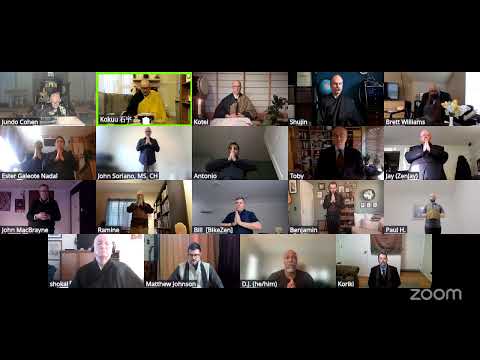
Our Jukai preparations, including the readings and sewing, are intended for those who feel called to undertake the Precepts at our Ceremony in January. However, even our members not participating in the Jukai this time are more than welcome to join in the readings and discussions, including both people who have never undertaken Jukai and those who have before.
In fact, can folks who have already undertaken Jukai undertake Jukai again? YES!! (And in such case, if you already have sewn a Rakusu with us in a prior year, you will not need to sew one this time (unless you wish to, of course, for it is always lovely to sew again.)
As well, please note that we will again combine this year's Jukai with our concentrated 90 DAY "ANGO" SPECIAL PRACTICE PERIOD (See below in this thread). We ask all Jukai participants to also join in our Ango activities this year to the best of their abilities, if healthy and otherwise able.
Actual study and sewing for the Jukai will begin from the evening of Friday, September 5th (Saturday, September 6th in some time zones), with our Monthly 3-Hour netcast Zazenkai at that time ... so please reflect on the following until then, and consider if you wish to walk this path ...

If you have any questions about Jukai, feel free to contact me by email. Please note that, if someone has a health or other circumstance which makes some aspect or activity of Jukai or Ango a hardship, please let me know and we will work out a different way. Please see the thread inside about our 'Alternative Paths' and various alternative accommodations that can be made in the requirements for Jukai and Ango for those with health needs.
.
We are flexible and accommodating in the case of anyone with health or other hardships which make participation in a particular activity difficult. Please let us know about any such concerns.
My teacher, Gudo Wafu Nishijima Roshi, has written that one may receive Jukai at any time, including at the very start of one’s Buddhist Path …
When a Buddhist seeks to commence upon the study of Buddhism, there is first a ceremony which should be undertaken: It is called ‘Jukai,’ the "Receipt of the Precepts”, the ceremony in which one receives and undertakes the Precepts as a disciple of the Buddha. … Master Dogen specifically left us a chapter entitled ‘Jukai,’ in which it is strongly emphasized that, when the Buddhist believer first sets out to commence Buddhist practice ….. be it monk, be it lay person, no matter ….. the initial needed steps include the holding of the ceremony of Jukai and the undertaking of the Precepts …
MORE DETAILS INSIDE (Forum Registration Necessary)
About Ango ....
Commencing on SEPTEMBER 5th, 2025 (with our Monthly 3-Hour netcast Zazenkai on that day, held on the evening of Friday, September 5th in most time zones, Saturday September 6th elsewhere)...
... AND CULMINATING WITH OUR "AT HOME" 2-DAY ROHATSU RETREAT (currently scheduled for the weekend of December 5th & 6th, via live netcast), our Treeleaf Sangha will hold our next traditional (yet "fully online") ...
.
"ANGO"
Ango, 安居 , literally “peaceful dwelling and abiding”, is a period of concentrated and committed Zen practice, usually lasting three months in the Soto Zen tradition, often in the summer but in other seasons as well. The roots of Ango arise from the earliest days of the Buddhist monastic community in India, when monks and nuns would cease their wandering and settle together in one place for the rainy season. Even today in Zen monasteries of Japan, Ango is a time of intense and rigorous training, typically including long hours of Zazen, short hours for sleep, formal meals taken in the Zendo (meditation hall), and a structured schedule for the rest of the day comprising periods for work, liturgy, study, rest, and personal needs. In the West, most Zen groups have adapted the form of the three month practice period to the needs and demands of life in their communities.
In keeping with the philosophy and path of practice here at Treeleaf (“all of life is our temple”), we will seek to obtain many of the same (and quite a few additional and very special) fruits and lessons of a traditional Ango while sitting within the “monastery” of our day-to-day lives, jobs, problems, unending distractions and family responsibilities.
In doing so we will have the opportunity to taste the sweetness (and sometime bitterness – not one without the other) of concentrated Zen practice, and learn lessons, in many ways more poignant, practical, immediate and powerful than what might be known even to monks locked away in a sheltered mountain monastery. As always, we will be tasting the power of this practice in the world, in daily life, not hidden away from it all.
As each person’s life situation, family and work responsibilities vary, we will be happy to consult with folks to adjust and design a practice schedule and content to fit those circumstances. However, the most important point to keep in mind is that those work duties at the office, daily problems, worries, illnesses, and family responsibilities ARE THE PRACTICE PLACE as much as the Zafu (sitting cushion). The home kitchen is the temple kitchen, the office, store or factory is a convent workplace, our sickbed or tending to the needs of another in need is the altar of Kannon, workshop or garden when we practice Samu (work practice), etc. Children and loved ones are your fellow temple residents who benefit from your labors. Each presents countless opportunities for practice, and for manifesting Wisdom and Compassion.
MORE DETAILS INSIDE (Forum Registration Necessary)
Gassho, Jundo
stlah